Showing posts with label Original. Show all posts

Wednesday, August 22, 2012

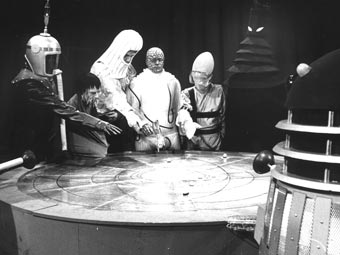
Original - Mission to the Unknown

Courtesy: TARDISwiki
Suspense.  Unknown sets up Masterplan beautifully ... from the stranded spacecraft to the Intergalactic council and ultimately a believable security operative Marc Cory.  Upon listening, it has a wonderful suspenseful atmosphere that was the very nature of the early Hartnells but was minimised as Innes Lloyd and Gerry Davis opted for the base-under-siege stories seemingly lit with spotlights left over from the war.  Doom stalks the rocket's crew - but not too quickly which only increases the audience's expectancy.  The pacing is just wonderful.

All this actually leads me to believe this serial is perhaps Terry Nation's best work.  OK, so he did The Daleks and The Daleks' Invasion of Earth isn't bad, but the best parts of Masterplan are unquestionably Dennis Spooner's work, while the same might be said of Genesis and Robert Holmes.  The dialogue here, so amped up and florid, denotes this as Nation's work just as effectively as the prefix space (as in space garbage, space medicine, space saving ad infinitum).  That said - and against all odds - the melodramatic script meshes perfectly with the inherent tension.

Evil.  In Life, the Universe and Everything, one-time Who script editor describes a the Krikkitmen's xenophobia as "cold, implacable ... not like ice is cold, but like a wall is cold ... And it was deadly - again, not like a bullet or a knife is deadly, but like a brick wall across a motorway is deadly."  And that's the perfect description of the Daleks in both Unknown and Masterplan.  And it's the how the Daleks are best portrayed: in their debut, this episode and it's big brother, Power, Evil, Genesis and, more recently, Dalek.


Courtesy: wikimedia commons
Prequel.  Mission to the Unknown was the prequel for a series solely centred on the Daleks; it obviously never happened.  Such a series would have had to focus on new human characters like Jason Cory and Sara Kingdom as basing an entire series on stilted shouting crosses into pure, naive idiocy - as it turned out, TV execs thought as I do.  As it happens, much of the mythology built up by Nation for this cutaway has been adopted as gospel by the expanded Whoniverse - the Special/Space Security Service and Varga plants chief among them.

The Daleks are kept in the background here - c.f. Evil/Revelation of the Daleks - and are perfectly capable of delivering extended dialogue; their presence ramps up the tension with the happy result that Unknown doesn't miss Hartnell, Purves and the female companion of the month at all.

In three words: Hartnell era's best?

Rating: 5.

Sunday, August 12, 2012

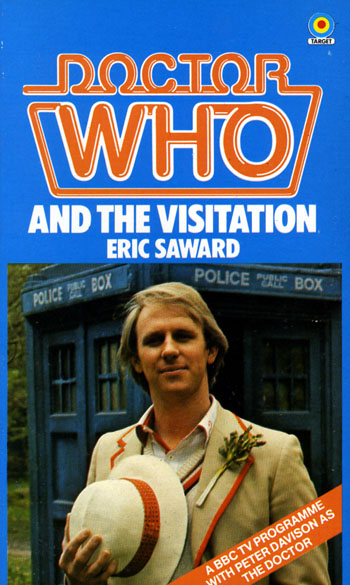
Original: The Visitation

Courtesy: ebay.com
Disco android.  Draw your own conclusions, but you can argue that Saward's best writing for Doctor Who was based around androids; certainly they feature heavily in his first three scripts.  The plot here, of Earthshock as well as Resurrection of the Daleks relies upon them but arguably only here is the android treated as a character: at the end of Episode 1, it strokes the key as it locks the crew in the house.  The Earthshock androids are brilliant as simple mechanical killers.  In contrast, Stien (Resurrection) is supposed to have much more depth but ends up being nothing more than a plot device.

The Brigadier would love the Terileptils.  Despite a hit/miss design based around early animatronics, the Terileptils are a reasonably well-conceived race but poorly characterised.  The concept of a warlike race treasuring art is interesting but this is mentioned only in one passage and on the whole they comes across as shouty and stereotypically evil despite a worthy back story.  Doctor Who's original run featured 17 attempted Earth invasions; only the Terileptils, the Aliens from The Faceless Ones, the Kraals and the Zygons aren't immune to bullets.  Combine this with a reliance on Soliton gas (what happens when their stores run out?) and suddenly they're rather lightweight.  However, our last view of one suggests an era three years in the future as a Terileptil's head melts while it groans in pain.

Budget.  Obviously Mace's hideout is a set taped with VT rather than a filmed stable.  How in holy hell is this cheaper than just finding an appropriate stable?

Adric's hairstyle.  That's all.

Actually, that's not all.  It has more personality than he does, leading to...

Companion woes.  There really isn't enough for all three to do, so Saward falls into the standard "out" of simply having one of them brainwashed or captured.  Adric serves no plot purpose whatsoever.  Due to their interplay, her seeming lack of angst, and her independent nature, you absolutely identify with Davison's assertion that he felt Nyssa fit him best as a companion.  Which in turn leads to...

Eric Saward obviously had some issues.  Adric's all about the teen angst.  The Terileptil leader is the shoutiest villain this side of Terry Molloy.  Tegan was devised as a mouthy character but just sounds bitchy.  Given that this script apparently won Saward the job as script editor, you have to wonder if Jon Nathan-Turner saw this conflict and said "There's my idea for my next Doctor and companion combination", or if Saward simply specialised in bitchiness and this manifested in his work.  The script drips with repressed anger; at times you can justify it and at others it's just irritating.

Davison's the best thing in this.  The story says that Peter Davison took the role as The Doctor because he wanted to "mature" into a leading man - as evidenced here, it takes him about two stories.  Despite some occasional delivery issues (he sometimes raises the pitch of his voice at the end of sentences, creating the implication of doubt - most notably in the Episode 3 cliffhanger) he quite compelling despite a script which sees his best lines shouted at by his opponent.  He also has remarkably little to do.

This makes it a typically Saward ending.  Eric Saward was notorious for thinking the Doctor's destinations as more interesting than his actions.  The serial ends with a scuffle in which the bakery is accidentally set alight - The Doctor does nothing to really inspire a conclusion.  The same can be said in later Saward stories like Earthshock, Attack of the Cybermen and Revelation of the Daleks.

Rating: 3.

In four words: Sets the Saward standard.

Wednesday, July 18, 2012

Review: Elisabeth Sladen - an autobiography

When Elisabeth Sladen passed away in April 2011, I was shocked and upset than at the death of any other of my childhood fiction stalwarts.  She consistent, intriguing and still on TV, but her death shook me up more so than even that of her co-star (and my then-hero) Jon Pertwee in 1996, despite that occurring in the midst of my cry-at-the-drop-of-a-hat phase.

Her most notable role by far was as Doctor Who's best ever companion, Sarah Jane Smith, a role she played, on-and-off for nearly forty years.  Her autobiography, released posthumously, is an interesting work which speaks volumes - in hushed tones - about the woman who would have preferred to be known as Elisabeth Miller.  Of course due to the vagaries of Equity, the UK actor's guild, that wasn't ever a possibility but contributes to the defining theme of her memoir, of someone utterly at home in family settings.

Tuesday, April 17, 2012

Original: The Three Doctors

Bob 'n' Dave.  Written by the boys from Bristol, The Three Doctors remains somewhat of a guilty pleasure of mine.  It's padded, is perhaps Sergeant Benton's greatest moment and features many of the era's most redoubtable guest stars in Roy Purcell, Clyde Pollitt, Rex Robinson and Stephen Thorne.  It's also interesting to note that it's in this serial that the Doctor finally breaks the Brigadier's mind when the series' other character known by title only decides that Pertwee has somehow regressed to Troughton.

This is, in a way, a bit unfair.  The Brigadier's seen enough crazy stuff to make him believe anything is possible so why shouldn't Pertwee change back into Troughton - it's hardly like the Doctor to explain, in-depth, the Time Lord penal code.  It's the pigheaded refusal to listen to Benton which makes the Brigadier seem so chump-ish here.  Well, this, and it's made worse by prior scenes (eg. from The Mutants where they emerge from the TARDIS and say "Don't tell the Brigadier, he'll never believe you").  By this stage of the series' evolution, The Brig (capital T, capital B) had become a parent figure that children - the most anti-establishment figures of them all - poke fun at for having no imagination.  That Pertwee's Doctor was the archetypal Mother Hen, swooping in to protect her children makes this all the more arch, seventies bliss.

Back to Bob 'n' Dave.  Bob 'n' Dave (Baker & Martin, if you insist) are symptomatic - along with each seasons' attempt at climactic maturation - of Who's transition from the hard-hitting alien invasion drama that Derrick Sherwin wanted (and Douglas Camfield would have been perfect to direct) to Barry Letts' and Terrance Dicks' family-time stories*.  Some suggest this process was less transition and more decay - personally I think Season 7 is the most consistently brilliant Who until 2005 - but this isn't entirely true.  No matter how excellent in retrospect, it wasn't Season 7 I first fell in love with.  As a toddler, I became infatuated with the UNIT family (Brig, Jo, Benton, Yates, several Jimmys and Corporal Bell), the Master, Daleks - and most definitely, the Pertwee Doctor.  He was my absolute, unassailable favourite until  I really got to grips with Troughton in my early-to-mid twenties.  

That said, Baker/Martin's scripts were rife with pun-sational or schmaltzy dialogue and they evidenced an ever-increasing desire to create marketable catchphrases ("Contact has been made") so that The Kids could tell what the bad guys were up to.  They, more than any other writers, were responsible for most of the "Don't tell the grown-ups" moments; unsurprising considering their background in childrens' television.

Stephen Thorne.  I love Stephen Thorne as Omega in this, I always have.  While you can slag off Bob 'n' Dave all you like for occasional cringeworthy lines ("I got the feeling they were more deadly enemies"), the idea of a man kept alive by will alone - coupled with the imagery of Omega removing his helmet to display nothing beneath - is absolutely brilliant television.  Thorne does absolute justice to the character, moving between inarticulate rage and boasting arrogance with finesse Bruce Purchase could only splutter at.  Thorne's rich, deep vocal portrayal makes Omega what he is despite a physically imposing frame.  Favourite line: "If I exist only by my will, then my will is to destroy!" - delivered with such unhinged insanity that you actually end up feeling for him.

Troughton.  While there were elements of Troughton's Doctor which emerged throughout the serial, he was actually written quite differently from his time as the lead.  He's impish, but without the occasional gravitas which typified many of his best lines.  It's nice to see him - and painful to see Hartnell, who was only 65 but looks every day of his character's 400 years - but you feel his Doctor is very much thought of as "the funny one".

In two words: Childhood relived.

Rating: 4.

* 51-word sentence.  Personal best!

Thursday, April 5, 2012

Liveblog: The Leisure Hive, episode 4

Titles:  So where were we?  Ah yes, we'd just left the aged Doctor, the French-dressed Romana and a chirruping insect to rip the face off another insect wearing a skin-suit.  Tell me, in which series could you fully expect to write an introductory sentence like that?  I love Doctor Who!

No matter what, though, I'm much more comfortable with Drs. Davison and Colin Baker in the "starfield" credits.  With Tom Baker, they just don't seem to feel right - too clean.  Tom Baker's best years were when the series had a real gritty feel to it.

Reprise: I don't get it - can the Doctor understand the Foamasi language?  And where did they find the second Foamasi?

Tuesday, April 3, 2012

Liveblog: The Leisure Hive, episode 3

Opening titles:  Let's talk (briefly) about music.  A friend of mine who's a classically trained composer once said he liked this version of the theme music better than any other Who music simply because it offered the right balance of melody and rhythm.  You've gotta hand it to him, he's right.  It really is a nice, iconic theme - probably the most well-remembered of them all, especially starting and finishing with the "sting".

Reprise: Well, it's obvious that the Argoin don't belong to anything like the Galactic Geneva Convention - this sort of thing would be highly frowned upon, using a prisoner as a guinea-pig for arcane experimentry.


Tuesday, March 27, 2012

Liveblog: The Leisure Hive episode 1

Credits: Bloody hell, that's a change from the old diamond-shaped logo!  At least, it would have been in 1980 when JNT commissioned Sid Sutton to create them.  Sutton then went on to create the similar (but more lurid) 6th Doctor title credits.

By: David Fisher, an underappreciated Doctor Who scriptwriter.  He doesn't rank in the top 5 (for mine, Holmes, Houghton, Hulke, Whitaker and *squints a bit* oh, let's go for John Lucarotti), but his work during a difficult era for Who is still under-regarded.  He had to write for an arrogant, narcissistic leading man who thought himself better at comedy that he was, a producer on a shoestring and three separate script editors who each wanted him completely different script styles from him.  That he did so well with stories like The Androids of Tara and the Stones of Blood is commendable ... if you thought the Hinchcliffe/Williams transition was jarring, try going from for-better-or-worse comic (Adams) to science-at-all-costs (Bidmead).

(Come to think of it, Fisher probably doesn't make the top 10 - I haven't mentioned Dicks, Sherwin, Haisman/Lincoln, Wyatt, Spooner or Cotton, yet).

Monday, February 20, 2012

Original - The Curse of Fenric

The Curse of Fenric is regarded as one of - if not the - seminal McCoy story.  It is part of the Ace crescendo, a key part of the so-called "Cartmel Masterplan" and features some of the best plotting of any post-Bidmead script.  It's also part of the thrum that led to such a successful Original Series sendoff, which climaxed so pleasingly with Survival (and created the Virgin New Adventures).  It's a little contrived at points, but we're talking about Doctor Who here, so that's forgiveable.  The biggest question mark on the whole "masterplan" - apart from whether it actually existed, if you do some reading - is why the Doctor feels the need to only reveal the plot in small morsels even though he apparently knows what's going on from the very beginning.  There's no real reason for it, and at times makes this incarnation quite frustrating.


The acting is relatively tight (except for Eastenders rejects serving as vampyrettes), with all of Millington, Rev. Wainwright, Judson and Kathleen Dudman being portrayed convincingly.  It is much more striking for the simple fact that's it's backed by quality production values - SFX, animatronics (?) and masks. 

Thinking outside the box.  Perhaps Ian Briggs' most impressive feature in this script is his lateral thinking skills.  The "chess" motif is done to death in nearly every media, but it's utilised well here - as is faith being the only defence against haemovores.  It is, however, unsurprising that there is an underlying pessimism about humanity's future given the serial was commissioned and edited by Andrew Cartmel (whose book Warlock) I found amongst the best of the Virgin New Adventures.

Even though the Cartmel Masterplan - and the Script Editor has implied he spent three years obsessed with Sophie Aldred - was discussed in point one, Ace's attempted-sexy "There's a storm coming" sequence is just embarrassing, for the writer and actor.  I don't care if it's part of the "coming of age" story arc, it's about as erotic as a wet fart and sounds only marginally better.  

In a word: Crescendo.

Rating: 4.