Showing posts with label 3. Show all posts

Monday, September 10, 2012

Review: Dinosaurs on a Spaceship

I don't get why people (I'm looking at you, Radio Free Skaro) rag on Chris Chibnall.  I'm not convinced he's the greatest script writer that Who has, but every single one of his scripts has been perfectly ... functional.  I'm a big fan of 42, while the Earth Reptile story in Series 5 didn't fascinate me, but was hardly dire.  To be honest, functional is the best assessment of Dinosaurs on a Spaceship.  It's enjoyable and engaging but this is balanced by the darker turn it takes in conclusion.

One of the script's more disappointing features is that although the oncoming missiles are references regularly, they in no way increase the tension. They, like Nefertiti and the Silurians, are simply there as plot expediencies.

The presence of historical figures Queen Nefertiti and the game hunter Riddell was odd.  That the Doctor would call someone who kills for sport a friend is jarring in the first place, but neither character actually served a specific script purpose that couldn't have been filled by a regular (or Rory's dad).  Their role was so sidelined that it actually cheapens their Nefertiti's involvement (Riddell being a fictional character).  "What else would be cool on a spaceship with dinosaurs? I know, a famous Egyptian queen!"

The predicably hackneyed interplay between guest companions didn't help, but also added to the epilogue's "biggest boy-girl left turn" since The Invasion of Time.  In so doing, the script cheapened Nefertiti's to add the element of "and we all lived happily ever after".  If you're going to give an explanation why a famous historical figure drops abruptly out of recorded sight, at least give them the dignity of an entire story about it, rather than a postscript.

Doctor Who Dinosaurs
Courtesy: seriable.com
It was a great acting performance by Rory and Brian Williams, wasn't it?  Their shared mannerisms made them an ultimately believable father-son duo.

Nefertiti and Riddell didn't need to be there, let alone travel in the TARDIS.  The current "Let's let anyone go for a ride in the TARDIS" thing doesn't synch with a man trying so obviously to keep a low profile.  Neither does it make you feel like the current "companions" are special - it's a wonderful, mind-blowing experience made valuable through it's rarity.  That the Doctor chooses to travel with someone is the most incredible gift, a journey that elevates a character from "acquaintance" to "friend".  With seemingly every second person taking a series of trips, the value of this gift decreases.

Although the Mitchell and Webb robots weren't my idea of how a robot should act, they can be easily explained away as "Someone in the galaxy thinks this is how robots interact".  However, it labours an already-loaded concept (dinosaurs, spaceships, silurians, Nefertiti and now squabbly robots).

It's obviously a script based around a title.  That said, the title says "fun" and that's Chibnall and director Saul Metzstein delivered.  Basing episodes on concepts (eg. Skeletons in spacesuits) can be hit or miss.  So it was a pleasant surprise when, despite the abject title, Chibnall's script was quite thoughtful. The Silurian presence was unexpected and the best possible story genesis, while using the almost-robotic Indian Space Agency was a deft touch that continued Who's estrangement from the new series' anchor point, early 21st century Britain.

In two words: Kiddie fun.

Rating: A solid 3.

Monday, August 13, 2012

PDA: Instruments of Darkness - Gary Russell

Gary Russell made me think!  No, really, he did a good thing!  279 pages weren't wasted!  It's a miracle!

Courtesy: doctorwhoreviews.co.uk
During his time writing Past Doctor Adventures, Russell made it a personal crusade to redeem the then-pilloried Sixth incarnation of the Time Lord, fleshing out the lurid continuity of the Colin Baker era.  First came Mel's official introductory story, Business Unusual - which I enjoyed - and eventually a real regeneration for Doc 6 in the form of the immortal Spiral Scratch.

It's campaigns like these that, despite the best of intentions, have earned Russell his reputation as a purveyor of the highest order of fanwank.

That said, however, despite myriad failings, Instruments of Darkness is a reasonable sequel to Business Unusual.

Irritations include a marginalised and relatively-poorly-characterised Doctor, reliance on continuity (although it's much better than some of the author's previous work), stylistic inconsistencies, dialogue peeled straight from the Star Wars prequels and Russell indulging his  Bond fetish.  Naming a pair of female assassins Ms de Menour and Ms (Mal) Feasance?  Inserting a piece about the Doctor introducing Fleming to the ornithologist on whom Bond was based?  The cult-series mix is simply too much for an admittedly-pulpy premise to bear.

But in spite of these elements, Russell deftly portrays a series of interconnected characters whose reliance upon each other is notable.  Throughout the text, couplets emerge where each member is completely dependent on the other - for existence, validation, love.  Even the Doctor is not immune as he encounters the companion that wasn't, Evelyn Smythe; and in fact only Mel appears immune.

This symbiosis is woven unobtrusively throughout and only it hits the reader with real force when it becomes apparent at the novel's conclusion.  It's sweetly juxtaposed with the climactic fireworks brought about by some old-school Doctor trickery reminiscent of Pyramids of Mars.

In two words: Mixed bag.

Rating: 3

Sunday, August 12, 2012

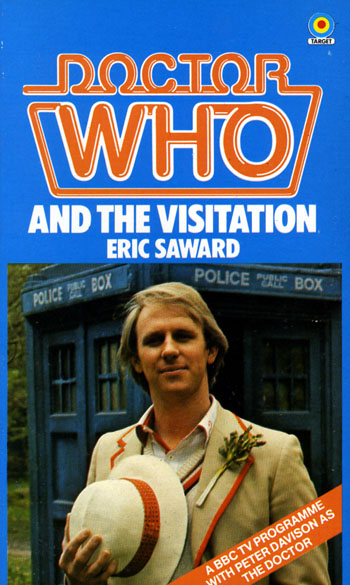
Original: The Visitation

Courtesy: ebay.com
Disco android.  Draw your own conclusions, but you can argue that Saward's best writing for Doctor Who was based around androids; certainly they feature heavily in his first three scripts.  The plot here, of Earthshock as well as Resurrection of the Daleks relies upon them but arguably only here is the android treated as a character: at the end of Episode 1, it strokes the key as it locks the crew in the house.  The Earthshock androids are brilliant as simple mechanical killers.  In contrast, Stien (Resurrection) is supposed to have much more depth but ends up being nothing more than a plot device.

The Brigadier would love the Terileptils.  Despite a hit/miss design based around early animatronics, the Terileptils are a reasonably well-conceived race but poorly characterised.  The concept of a warlike race treasuring art is interesting but this is mentioned only in one passage and on the whole they comes across as shouty and stereotypically evil despite a worthy back story.  Doctor Who's original run featured 17 attempted Earth invasions; only the Terileptils, the Aliens from The Faceless Ones, the Kraals and the Zygons aren't immune to bullets.  Combine this with a reliance on Soliton gas (what happens when their stores run out?) and suddenly they're rather lightweight.  However, our last view of one suggests an era three years in the future as a Terileptil's head melts while it groans in pain.

Budget.  Obviously Mace's hideout is a set taped with VT rather than a filmed stable.  How in holy hell is this cheaper than just finding an appropriate stable?

Adric's hairstyle.  That's all.

Actually, that's not all.  It has more personality than he does, leading to...

Companion woes.  There really isn't enough for all three to do, so Saward falls into the standard "out" of simply having one of them brainwashed or captured.  Adric serves no plot purpose whatsoever.  Due to their interplay, her seeming lack of angst, and her independent nature, you absolutely identify with Davison's assertion that he felt Nyssa fit him best as a companion.  Which in turn leads to...

Eric Saward obviously had some issues.  Adric's all about the teen angst.  The Terileptil leader is the shoutiest villain this side of Terry Molloy.  Tegan was devised as a mouthy character but just sounds bitchy.  Given that this script apparently won Saward the job as script editor, you have to wonder if Jon Nathan-Turner saw this conflict and said "There's my idea for my next Doctor and companion combination", or if Saward simply specialised in bitchiness and this manifested in his work.  The script drips with repressed anger; at times you can justify it and at others it's just irritating.

Davison's the best thing in this.  The story says that Peter Davison took the role as The Doctor because he wanted to "mature" into a leading man - as evidenced here, it takes him about two stories.  Despite some occasional delivery issues (he sometimes raises the pitch of his voice at the end of sentences, creating the implication of doubt - most notably in the Episode 3 cliffhanger) he quite compelling despite a script which sees his best lines shouted at by his opponent.  He also has remarkably little to do.

This makes it a typically Saward ending.  Eric Saward was notorious for thinking the Doctor's destinations as more interesting than his actions.  The serial ends with a scuffle in which the bakery is accidentally set alight - The Doctor does nothing to really inspire a conclusion.  The same can be said in later Saward stories like Earthshock, Attack of the Cybermen and Revelation of the Daleks.

Rating: 3.

In four words: Sets the Saward standard.

Thursday, April 5, 2012

Liveblog: The Leisure Hive, episode 4

Titles:  So where were we?  Ah yes, we'd just left the aged Doctor, the French-dressed Romana and a chirruping insect to rip the face off another insect wearing a skin-suit.  Tell me, in which series could you fully expect to write an introductory sentence like that?  I love Doctor Who!

No matter what, though, I'm much more comfortable with Drs. Davison and Colin Baker in the "starfield" credits.  With Tom Baker, they just don't seem to feel right - too clean.  Tom Baker's best years were when the series had a real gritty feel to it.

Reprise: I don't get it - can the Doctor understand the Foamasi language?  And where did they find the second Foamasi?

Friday, February 24, 2012

Other - The Discontinuity Guide, by Cornell, Day and Topping

Originally excited to have finally found a second-hand copy, I was surprised by it's scatter-gun approach.  Each story is laid out in categories where often there is no explanation, minimal linking and less style.  As a book, written by three of the Whoniverse's leading anoraks, The Discontinuity Guide is for superfans who don't need much context to understand subtle references.  If this is your target audience (and where else could they be aiming?) this is fine, but makes it lightweight and somewhat engaging.

courtesy: tardis.wikia.com
That they devote an entire section in each story to risible double entendres - grasping every possible reference no matter how banal - is the kind of thing that makes authors look back and shudder at their apparently virginal mid-nineties.  Their description of The Horns of Nimon as "Rather wonderful with some friends and a bottle of wine" only serves to emphasise this fact - no matter how true it may/may not be.  Although marketed as humour, it isn't - it takes a lot to make a book of lists funny.

Genre-defining. For it's numerous bad points, The Discontinuity Guide was the first light-hearted series guide written by fans since the party-line days of Peter Haining, Adrian Rigelsford and the factless Jean-Marc Lofficier.  It was written by guys who obviously cared about the series, had moderate knowledge of TV production - by educated fans, for educated fans.  Since it's initial appearance in 1995, it has spawned several internet-based imitations, including one which actually bears the same title; as well as starting the ball rolling towards the definitive Who guides: Lawrence Miles & Tat Wood's About Time series.

In a word: Platform.

Rating: 3.