Monday, August 13, 2012

PDA: Instruments of Darkness - Gary Russell

Gary Russell made me think!  No, really, he did a good thing!  279 pages weren't wasted!  It's a miracle!

Courtesy: doctorwhoreviews.co.uk
During his time writing Past Doctor Adventures, Russell made it a personal crusade to redeem the then-pilloried Sixth incarnation of the Time Lord, fleshing out the lurid continuity of the Colin Baker era.  First came Mel's official introductory story, Business Unusual - which I enjoyed - and eventually a real regeneration for Doc 6 in the form of the immortal Spiral Scratch.

It's campaigns like these that, despite the best of intentions, have earned Russell his reputation as a purveyor of the highest order of fanwank.

That said, however, despite myriad failings, Instruments of Darkness is a reasonable sequel to Business Unusual.

Irritations include a marginalised and relatively-poorly-characterised Doctor, reliance on continuity (although it's much better than some of the author's previous work), stylistic inconsistencies, dialogue peeled straight from the Star Wars prequels and Russell indulging his  Bond fetish.  Naming a pair of female assassins Ms de Menour and Ms (Mal) Feasance?  Inserting a piece about the Doctor introducing Fleming to the ornithologist on whom Bond was based?  The cult-series mix is simply too much for an admittedly-pulpy premise to bear.

But in spite of these elements, Russell deftly portrays a series of interconnected characters whose reliance upon each other is notable.  Throughout the text, couplets emerge where each member is completely dependent on the other - for existence, validation, love.  Even the Doctor is not immune as he encounters the companion that wasn't, Evelyn Smythe; and in fact only Mel appears immune.

This symbiosis is woven unobtrusively throughout and only it hits the reader with real force when it becomes apparent at the novel's conclusion.  It's sweetly juxtaposed with the climactic fireworks brought about by some old-school Doctor trickery reminiscent of Pyramids of Mars.

In two words: Mixed bag.

Rating: 3

Sunday, August 12, 2012

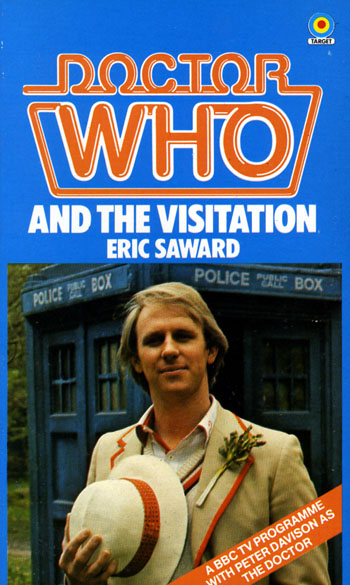
Original: The Visitation

Courtesy: ebay.com
Disco android.  Draw your own conclusions, but you can argue that Saward's best writing for Doctor Who was based around androids; certainly they feature heavily in his first three scripts.  The plot here, of Earthshock as well as Resurrection of the Daleks relies upon them but arguably only here is the android treated as a character: at the end of Episode 1, it strokes the key as it locks the crew in the house.  The Earthshock androids are brilliant as simple mechanical killers.  In contrast, Stien (Resurrection) is supposed to have much more depth but ends up being nothing more than a plot device.

The Brigadier would love the Terileptils.  Despite a hit/miss design based around early animatronics, the Terileptils are a reasonably well-conceived race but poorly characterised.  The concept of a warlike race treasuring art is interesting but this is mentioned only in one passage and on the whole they comes across as shouty and stereotypically evil despite a worthy back story.  Doctor Who's original run featured 17 attempted Earth invasions; only the Terileptils, the Aliens from The Faceless Ones, the Kraals and the Zygons aren't immune to bullets.  Combine this with a reliance on Soliton gas (what happens when their stores run out?) and suddenly they're rather lightweight.  However, our last view of one suggests an era three years in the future as a Terileptil's head melts while it groans in pain.

Budget.  Obviously Mace's hideout is a set taped with VT rather than a filmed stable.  How in holy hell is this cheaper than just finding an appropriate stable?

Adric's hairstyle.  That's all.

Actually, that's not all.  It has more personality than he does, leading to...

Companion woes.  There really isn't enough for all three to do, so Saward falls into the standard "out" of simply having one of them brainwashed or captured.  Adric serves no plot purpose whatsoever.  Due to their interplay, her seeming lack of angst, and her independent nature, you absolutely identify with Davison's assertion that he felt Nyssa fit him best as a companion.  Which in turn leads to...

Eric Saward obviously had some issues.  Adric's all about the teen angst.  The Terileptil leader is the shoutiest villain this side of Terry Molloy.  Tegan was devised as a mouthy character but just sounds bitchy.  Given that this script apparently won Saward the job as script editor, you have to wonder if Jon Nathan-Turner saw this conflict and said "There's my idea for my next Doctor and companion combination", or if Saward simply specialised in bitchiness and this manifested in his work.  The script drips with repressed anger; at times you can justify it and at others it's just irritating.

Davison's the best thing in this.  The story says that Peter Davison took the role as The Doctor because he wanted to "mature" into a leading man - as evidenced here, it takes him about two stories.  Despite some occasional delivery issues (he sometimes raises the pitch of his voice at the end of sentences, creating the implication of doubt - most notably in the Episode 3 cliffhanger) he quite compelling despite a script which sees his best lines shouted at by his opponent.  He also has remarkably little to do.

This makes it a typically Saward ending.  Eric Saward was notorious for thinking the Doctor's destinations as more interesting than his actions.  The serial ends with a scuffle in which the bakery is accidentally set alight - The Doctor does nothing to really inspire a conclusion.  The same can be said in later Saward stories like Earthshock, Attack of the Cybermen and Revelation of the Daleks.

Rating: 3.

In four words: Sets the Saward standard.

Wednesday, July 18, 2012

Review: Elisabeth Sladen - an autobiography

When Elisabeth Sladen passed away in April 2011, I was shocked and upset than at the death of any other of my childhood fiction stalwarts.  She consistent, intriguing and still on TV, but her death shook me up more so than even that of her co-star (and my then-hero) Jon Pertwee in 1996, despite that occurring in the midst of my cry-at-the-drop-of-a-hat phase.

Her most notable role by far was as Doctor Who's best ever companion, Sarah Jane Smith, a role she played, on-and-off for nearly forty years.  Her autobiography, released posthumously, is an interesting work which speaks volumes - in hushed tones - about the woman who would have preferred to be known as Elisabeth Miller.  Of course due to the vagaries of Equity, the UK actor's guild, that wasn't ever a possibility but contributes to the defining theme of her memoir, of someone utterly at home in family settings.

Wednesday, July 11, 2012

Original series audio: The Massacre

Chaplet(te) Vocal Stylings:  Unfortunately, neither Jackie Lane - who'll become renowned during her stay on the show for this - nor Annette Robinson (Anne Chaplette) really know which accent they're supposed to be using at which time.  There's a dearth of consistency in their accents, but they very well may be related, so at least we can call it a genetic disposition.  We can (kind of) forgive Jackie Lane as her character started off planned as a cockney but was forced to change when Beeb management decided the only possible accent for a consistent character was the Received Pronunciation.  That notwithstanding, it's some pretty terrible Cockney/Nor'n/Mummerset going on between ostensible relatives.

Similarity to New Series themes: Many Whovians will be familiar with the haunting soliloquy Hartnell delivers when Steven leaves the TARDIS on Wimbledon Common at the conclusion of the story.  However, it's not the standard, feisty, confident Hartnell we've come to expect, nor even the same decisive Doctor of the past four episodes.  It's the first ever appearance of the Lonely God, a mere forty-two (Oh boy, there's a draw for you!) years before Russell T. Davies coined the phrase.  I don't care what anyone says, I defy you to tell me Hartnell has ever been better.

Courtesy: doctorwhoreviews.co.uk
If Sophia Myles' wonderful Madame du Pompadour was the first offical Moffat "Girl who Waited", then Anne Chaplet was her prototype.  She does little else but spend four episodes afraid for her life where layer upon layer of threat is piled upon her.  Not counting Mission to the Unknown, this is the first ever Doctor-Lite story as well and also perhaps the first pure "companion character study".  There are also harkens to the Tennant story "Fires of Pompeii", where the Doctor refuses to get involved in a great tragedy.

It's incredible upon first listening (true, the first time I've ever listened to this story despite reading the Target novelisation in 1993) how similar many of these methods are reiterated in the New Series.  Next up for Moffat et al: a return for the pure historical?

Intensity:  It's got Steven in it, so it's likely going to be rather erm, focused... Most of the dialogue is delivered with almost Shatner-like intensity, spat/spoken/shouted/whispered as if the lines are lethal projectiles.  This only adds to the serial, making you appreciate simply how much is at stake in a historical episode about which not many people are aware.  In order to make this sink in to the audience, Lucarotti and Tosh had to make identifiable characters to stop us from saying "Yeah, but so what"?  Remember too, that this has so much gravitas because of its context, transposed between two historicals penned by Donald Cotton.

Rating: 4

In a word: Prescient.

Tuesday, April 17, 2012

Original: The Three Doctors

Bob 'n' Dave.  Written by the boys from Bristol, The Three Doctors remains somewhat of a guilty pleasure of mine.  It's padded, is perhaps Sergeant Benton's greatest moment and features many of the era's most redoubtable guest stars in Roy Purcell, Clyde Pollitt, Rex Robinson and Stephen Thorne.  It's also interesting to note that it's in this serial that the Doctor finally breaks the Brigadier's mind when the series' other character known by title only decides that Pertwee has somehow regressed to Troughton.

This is, in a way, a bit unfair.  The Brigadier's seen enough crazy stuff to make him believe anything is possible so why shouldn't Pertwee change back into Troughton - it's hardly like the Doctor to explain, in-depth, the Time Lord penal code.  It's the pigheaded refusal to listen to Benton which makes the Brigadier seem so chump-ish here.  Well, this, and it's made worse by prior scenes (eg. from The Mutants where they emerge from the TARDIS and say "Don't tell the Brigadier, he'll never believe you").  By this stage of the series' evolution, The Brig (capital T, capital B) had become a parent figure that children - the most anti-establishment figures of them all - poke fun at for having no imagination.  That Pertwee's Doctor was the archetypal Mother Hen, swooping in to protect her children makes this all the more arch, seventies bliss.

Back to Bob 'n' Dave.  Bob 'n' Dave (Baker & Martin, if you insist) are symptomatic - along with each seasons' attempt at climactic maturation - of Who's transition from the hard-hitting alien invasion drama that Derrick Sherwin wanted (and Douglas Camfield would have been perfect to direct) to Barry Letts' and Terrance Dicks' family-time stories*.  Some suggest this process was less transition and more decay - personally I think Season 7 is the most consistently brilliant Who until 2005 - but this isn't entirely true.  No matter how excellent in retrospect, it wasn't Season 7 I first fell in love with.  As a toddler, I became infatuated with the UNIT family (Brig, Jo, Benton, Yates, several Jimmys and Corporal Bell), the Master, Daleks - and most definitely, the Pertwee Doctor.  He was my absolute, unassailable favourite until  I really got to grips with Troughton in my early-to-mid twenties.  

That said, Baker/Martin's scripts were rife with pun-sational or schmaltzy dialogue and they evidenced an ever-increasing desire to create marketable catchphrases ("Contact has been made") so that The Kids could tell what the bad guys were up to.  They, more than any other writers, were responsible for most of the "Don't tell the grown-ups" moments; unsurprising considering their background in childrens' television.

Stephen Thorne.  I love Stephen Thorne as Omega in this, I always have.  While you can slag off Bob 'n' Dave all you like for occasional cringeworthy lines ("I got the feeling they were more deadly enemies"), the idea of a man kept alive by will alone - coupled with the imagery of Omega removing his helmet to display nothing beneath - is absolutely brilliant television.  Thorne does absolute justice to the character, moving between inarticulate rage and boasting arrogance with finesse Bruce Purchase could only splutter at.  Thorne's rich, deep vocal portrayal makes Omega what he is despite a physically imposing frame.  Favourite line: "If I exist only by my will, then my will is to destroy!" - delivered with such unhinged insanity that you actually end up feeling for him.

Troughton.  While there were elements of Troughton's Doctor which emerged throughout the serial, he was actually written quite differently from his time as the lead.  He's impish, but without the occasional gravitas which typified many of his best lines.  It's nice to see him - and painful to see Hartnell, who was only 65 but looks every day of his character's 400 years - but you feel his Doctor is very much thought of as "the funny one".

In two words: Childhood relived.

Rating: 4.

* 51-word sentence.  Personal best!

Thursday, April 5, 2012

Liveblog: The Leisure Hive, episode 4

Titles:  So where were we?  Ah yes, we'd just left the aged Doctor, the French-dressed Romana and a chirruping insect to rip the face off another insect wearing a skin-suit.  Tell me, in which series could you fully expect to write an introductory sentence like that?  I love Doctor Who!

No matter what, though, I'm much more comfortable with Drs. Davison and Colin Baker in the "starfield" credits.  With Tom Baker, they just don't seem to feel right - too clean.  Tom Baker's best years were when the series had a real gritty feel to it.

Reprise: I don't get it - can the Doctor understand the Foamasi language?  And where did they find the second Foamasi?

Tuesday, April 3, 2012

Liveblog: The Leisure Hive, episode 3

Opening titles:  Let's talk (briefly) about music.  A friend of mine who's a classically trained composer once said he liked this version of the theme music better than any other Who music simply because it offered the right balance of melody and rhythm.  You've gotta hand it to him, he's right.  It really is a nice, iconic theme - probably the most well-remembered of them all, especially starting and finishing with the "sting".

Reprise: Well, it's obvious that the Argoin don't belong to anything like the Galactic Geneva Convention - this sort of thing would be highly frowned upon, using a prisoner as a guinea-pig for arcane experimentry.