
Showing posts with label review. Show all posts

Sunday, August 12, 2012

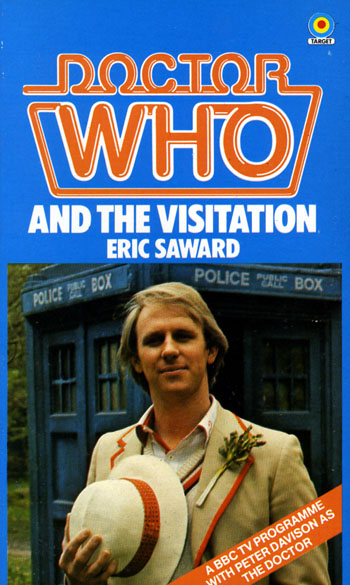
Original: The Visitation

Courtesy: ebay.com
Disco android.  Draw your own conclusions, but you can argue that Saward's best writing for Doctor Who was based around androids; certainly they feature heavily in his first three scripts.  The plot here, of Earthshock as well as Resurrection of the Daleks relies upon them but arguably only here is the android treated as a character: at the end of Episode 1, it strokes the key as it locks the crew in the house.  The Earthshock androids are brilliant as simple mechanical killers.  In contrast, Stien (Resurrection) is supposed to have much more depth but ends up being nothing more than a plot device.

The Brigadier would love the Terileptils.  Despite a hit/miss design based around early animatronics, the Terileptils are a reasonably well-conceived race but poorly characterised.  The concept of a warlike race treasuring art is interesting but this is mentioned only in one passage and on the whole they comes across as shouty and stereotypically evil despite a worthy back story.  Doctor Who's original run featured 17 attempted Earth invasions; only the Terileptils, the Aliens from The Faceless Ones, the Kraals and the Zygons aren't immune to bullets.  Combine this with a reliance on Soliton gas (what happens when their stores run out?) and suddenly they're rather lightweight.  However, our last view of one suggests an era three years in the future as a Terileptil's head melts while it groans in pain.

Budget.  Obviously Mace's hideout is a set taped with VT rather than a filmed stable.  How in holy hell is this cheaper than just finding an appropriate stable?

Adric's hairstyle.  That's all.

Actually, that's not all.  It has more personality than he does, leading to...

Companion woes.  There really isn't enough for all three to do, so Saward falls into the standard "out" of simply having one of them brainwashed or captured.  Adric serves no plot purpose whatsoever.  Due to their interplay, her seeming lack of angst, and her independent nature, you absolutely identify with Davison's assertion that he felt Nyssa fit him best as a companion.  Which in turn leads to...

Eric Saward obviously had some issues.  Adric's all about the teen angst.  The Terileptil leader is the shoutiest villain this side of Terry Molloy.  Tegan was devised as a mouthy character but just sounds bitchy.  Given that this script apparently won Saward the job as script editor, you have to wonder if Jon Nathan-Turner saw this conflict and said "There's my idea for my next Doctor and companion combination", or if Saward simply specialised in bitchiness and this manifested in his work.  The script drips with repressed anger; at times you can justify it and at others it's just irritating.

Davison's the best thing in this.  The story says that Peter Davison took the role as The Doctor because he wanted to "mature" into a leading man - as evidenced here, it takes him about two stories.  Despite some occasional delivery issues (he sometimes raises the pitch of his voice at the end of sentences, creating the implication of doubt - most notably in the Episode 3 cliffhanger) he quite compelling despite a script which sees his best lines shouted at by his opponent.  He also has remarkably little to do.

This makes it a typically Saward ending.  Eric Saward was notorious for thinking the Doctor's destinations as more interesting than his actions.  The serial ends with a scuffle in which the bakery is accidentally set alight - The Doctor does nothing to really inspire a conclusion.  The same can be said in later Saward stories like Earthshock, Attack of the Cybermen and Revelation of the Daleks.

Rating: 3.

In four words: Sets the Saward standard.

Tuesday, April 17, 2012

Original: The Three Doctors

Bob 'n' Dave.  Written by the boys from Bristol, The Three Doctors remains somewhat of a guilty pleasure of mine.  It's padded, is perhaps Sergeant Benton's greatest moment and features many of the era's most redoubtable guest stars in Roy Purcell, Clyde Pollitt, Rex Robinson and Stephen Thorne.  It's also interesting to note that it's in this serial that the Doctor finally breaks the Brigadier's mind when the series' other character known by title only decides that Pertwee has somehow regressed to Troughton.

This is, in a way, a bit unfair.  The Brigadier's seen enough crazy stuff to make him believe anything is possible so why shouldn't Pertwee change back into Troughton - it's hardly like the Doctor to explain, in-depth, the Time Lord penal code.  It's the pigheaded refusal to listen to Benton which makes the Brigadier seem so chump-ish here.  Well, this, and it's made worse by prior scenes (eg. from The Mutants where they emerge from the TARDIS and say "Don't tell the Brigadier, he'll never believe you").  By this stage of the series' evolution, The Brig (capital T, capital B) had become a parent figure that children - the most anti-establishment figures of them all - poke fun at for having no imagination.  That Pertwee's Doctor was the archetypal Mother Hen, swooping in to protect her children makes this all the more arch, seventies bliss.

Back to Bob 'n' Dave.  Bob 'n' Dave (Baker & Martin, if you insist) are symptomatic - along with each seasons' attempt at climactic maturation - of Who's transition from the hard-hitting alien invasion drama that Derrick Sherwin wanted (and Douglas Camfield would have been perfect to direct) to Barry Letts' and Terrance Dicks' family-time stories*.  Some suggest this process was less transition and more decay - personally I think Season 7 is the most consistently brilliant Who until 2005 - but this isn't entirely true.  No matter how excellent in retrospect, it wasn't Season 7 I first fell in love with.  As a toddler, I became infatuated with the UNIT family (Brig, Jo, Benton, Yates, several Jimmys and Corporal Bell), the Master, Daleks - and most definitely, the Pertwee Doctor.  He was my absolute, unassailable favourite until  I really got to grips with Troughton in my early-to-mid twenties.  

That said, Baker/Martin's scripts were rife with pun-sational or schmaltzy dialogue and they evidenced an ever-increasing desire to create marketable catchphrases ("Contact has been made") so that The Kids could tell what the bad guys were up to.  They, more than any other writers, were responsible for most of the "Don't tell the grown-ups" moments; unsurprising considering their background in childrens' television.

Stephen Thorne.  I love Stephen Thorne as Omega in this, I always have.  While you can slag off Bob 'n' Dave all you like for occasional cringeworthy lines ("I got the feeling they were more deadly enemies"), the idea of a man kept alive by will alone - coupled with the imagery of Omega removing his helmet to display nothing beneath - is absolutely brilliant television.  Thorne does absolute justice to the character, moving between inarticulate rage and boasting arrogance with finesse Bruce Purchase could only splutter at.  Thorne's rich, deep vocal portrayal makes Omega what he is despite a physically imposing frame.  Favourite line: "If I exist only by my will, then my will is to destroy!" - delivered with such unhinged insanity that you actually end up feeling for him.

Troughton.  While there were elements of Troughton's Doctor which emerged throughout the serial, he was actually written quite differently from his time as the lead.  He's impish, but without the occasional gravitas which typified many of his best lines.  It's nice to see him - and painful to see Hartnell, who was only 65 but looks every day of his character's 400 years - but you feel his Doctor is very much thought of as "the funny one".

In two words: Childhood relived.

Rating: 4.

* 51-word sentence.  Personal best!

Friday, February 17, 2012

New Adventure: City at World's End - Christopher Bulis

Since receiving my first Doctor Who novelization in 1986 (the much-misunderstood The Gunfighters), I’ve managed to collect a rather surprising amount of Who-related books; fiction and non-fiction, real-world production information and plain, simple fantasy. I don’t read them much anymore (this is the first Who book reviewed on BwB), but occasionally delve into one to really get a feel for my teen years again.

And City at World’s End is almost certainly the worst Doctor Who novel I’ve read, and I’ve read the ultimate testament to fanboy continuity-geekdom, War of the Daleks. City, by Christopher Bulis, was one of the earlier BBC Books attempts to carry on the Doctor’s adventures while the TV show was on hiatus between 1989-2005.

Who took on a life of it’s own after the ’89 cancellation, as books describing “Missing” or “New” adventures of the Time Lord were published by various enterprises. Many of these (cough, War of the Daleks, cough) came straight from fanboys and were astonishing in their ability to turn one line of dialogue from a single episode broadcast in 1973 into entire 279-page novels. (For some reason, novelizations of the original serials – two 23-minute long episodes or ten - were almost always fit into 127-page books; for the New/Missing adventures it’s 279).

It’s this kind of backstory which explains the Who dichotomy. Because of it’s wonderfully simply and unique format, Who-fiction can be purely derivative stuff, completely original – and is often both. Take for example the 2007 broadcast stories “Human Nature” and “Family of the Blood”. These stories were written by Paul Cornell, who adapted his 1995 novel “Human Nature” to suit the reimagined series’ head honcho Russell T. Davies’ story arc allowing the Doctor’s nemesis to be re-born.

It turns out that the Master appeared in a story (Utopia) very much like this one – a group of humans building a rocket to escape their world’s apocalypse, all the time under threat by hostile aliens. I hope RTD wasn’t aware of this book when plotting Utopia, because the series deserves much better. City at World’s End is an appalling piece of fiction – even if, in embryo, the idea has merit.

City is remarkably poorly put together. It’s as transparent as a glass of water and features several (alleged) subplots which are both boring, useless – thus, utterly flawed – before they all converge nowhere. Typical Whoniverse “religion is blind and corrupt” themes (cf. 1984’s Planet of Fire) aren’t so much hinted at as shouted from the mountain tops. There’s nothing wrong with a simple plot, as long as it’s paced well – a great example of this is the early Bond novels.

Pity is, we’ve covered most of our review space and haven’t even gotten to the words yet. The “adventure” is headlined by the original TARDIS crew of the Doctor (as portrayed by William Hartnell), his granddaughter Susan as well as English schoolteachers Ian and Barbara. Hartnell, whose mannerisms should make writing for him a relative doddle (as compared to the real, as opposed to remembered, Tom Baker years) is characterized less as a gentleman traveler and speaks words like a bored telephone sales operative.

Bulis throws about verbs like a ham-fisted bun vendor and completely fails to apply any sense of urgency to what we’re told is a desperate situation. He even trots out that “give every clue it’s a main character, but don’t refer to them by name until the very end of the chapter” hackneyed crap. The prelude (and first half of the book) were of such stunning shoddiness that I only continued reading so as to see a) how bad it could get and b) how much I could pan it in a review.

Much of these flaws can be repaired, however, given a good editing job. Unfortunately, being able to poke so many holes is almost every aspect of the book means the editor (at that time one of Stephen Cole or Justin Richards) must have been on a horrible deadline, as the book is laughably incoherent. By now, the series (of books) was obviously being run by the fan-boys on Adamsian-style deadlines.

In short, the book doesn’t deserve even half of the column inches I’ve devoted to it. Sorry.

In a word: Unedited.

Rating:  1.